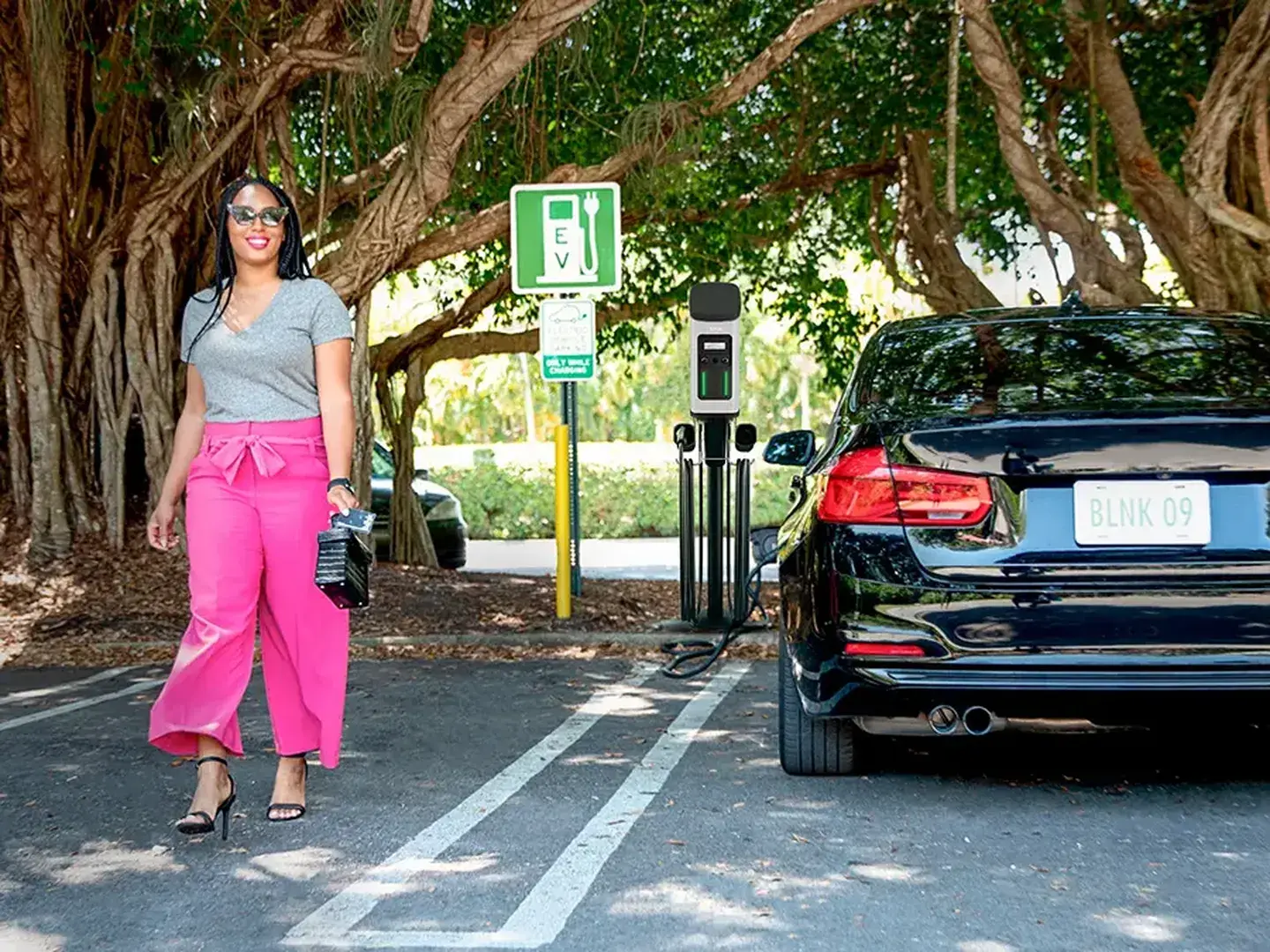
Because the converter electronics in a DCFC are larger and more powerful than those in an EV, DCFC charging is so much faster than Level 1 and Level 2 charging. With Level 1 and Level 2, the AC to DC conversion happens inside the EVs onboard charger, while with DCFC, the conversion occurs in the station itself. Your vehicle’s onboard charger isn’t involved when using a DCFC.
Now that we’ve covered how an EV's battery is charged, let’s discuss how voltage, amperage, and kilowatts work together to affect charging speed.
Volts, amps, kilowatts, and your EV
What Are EV Charger Amps?
EV charger amps, or amperage, refer to the amount of electrical current an EV charger can deliver to your vehicle. Amperage plays a major role in charging speed because higher amp chargers can deliver more power to your EV's battery, provided your vehicle and electrical system can support it.
Most home EV chargers operate between 16 and 48 amps. However, the ideal charger depends on your vehicle's maximum charging capability and the available capacity of your home's electrical panel.
How Amperage Affects Charging Speed
Charging speed is determined by both amperage and voltage. Together, they create charging power, which is measured in kilowatts (kW).
A simple way to think about it is:
Voltage is the electrical pressure.
Amperage is the electrical flow.
Voltage × Amperage = Charging Power (kW).
For example, a 240-volt charger delivering 32 amps provides about 7.7 kW of charging power, while a 48-amp charger can deliver approximately 11.5 kW.
Level 2 charging amperages
Level 2 charging units in North America run on 240 volts, the same as your oven or clothes dryer, providing a steady pressure of 240 volts of electricity. These stations come with various amperage ratings to meet the power needs of different EVs. For instance, the Blink Series 7 Level 2 Charging Station can deliver up to 80 amps of power to your EV. (Note that residential homes typically have a 240V service, while commercial buildings have 208V, and Blink’s Level 2 charging stations are compatible with both.)
However, a higher amperage rating on a Level 2 EV charging station doesn’t necessarily mean quicker charging.
This is because your EV battery can only safely handle a certain number of kilowatts. Each EV has a kilowatt rating that indicates how much power the battery can accept. Generally, EVs have two power ratings: a lower AC power and a higher DC power. For example, if your EV can charge up to 7.2 kW, it will only accept up to 7.2 kW of electrical power.
To determine how much power will flow to your EV's battery, find the lesser value between your EV onboard charger power and the maximum charging station power. You can calculate the maximum charging station power using the following formulas:
Let’s see how this works with some examples.
Example 1
A 240 V Level 2 charging station with a 30 amp rating will deliver 7.2 kW of electricity to your EV battery.
240 V x 30 A = 7,200 W
7,200 W ÷ 1,000 = 7.2 kW
This Level 2 charging station can provide up to 7.2 kW.
Example 2
If we replace the 30 amp charging station with an 80 amp Level 2 station, the result changes:
This Level 2 charging station can supply up to 19.2 kW of power.
How the EV maximum charging rate affects charging
Now let’s discuss your EV's maximum charging rate, which is the highest amount of power the battery can safely accept, regardless of the power supplied by the EV charging station.
Suppose you have an EV with a 7.2 kW rating. This means if you use the charging station from Example 1, your EV can accept the full 7.2 kW of power that the charging station can supply.
However, if you plug this same EV into the charging station from Example 2, it can still only accept a maximum of 7.2 kW of power. This is because the EVs onboard charger will never accept more than 7.2 kW of power. No matter how much power the charging station provides, the onboard charger can only handle its maximum rating of 7.2 kW.
Note that DC fast chargers (DCFCs), like the Blink All-In-One Station Charger, Blink 60kW - 360kW DCFC, and Blink Hypercharger 400kW DCFC bypass the vehicle’s onboard charger and charge the battery differently. Therefore, these rating are not applicable to DCFCs.